29 August 2006

Anniversaries

August 19, 2006, was the 70th anniversary of the assassination of Spanish poet and dramatist Federico Garcia Lorca. Murdered by fascist troops during the early stages of the Spanish Civil War, this world-class writer and activist was only 36 years old. I first encounterd Lorca's writings in high school, and his work was one of the 'gateway drugs' that started me off on my continuing love of poetry. I also remember, back in high school, a group of teachers talking about him, and in talking about his death, one said contemporaries were not sure if he was killed 'por eso o por el otro' ('for this or for that' -- literally 'for this or for the other'). There was a quiet, slightly uncomfortable moment in the teacher's room, as no one wanted to come out and make explicit in front of the 14 or 15 year old me what the phrase referred to (but what I'd already either known or had suspected): the question of whether he was killed because of his politics or because he was a gay man.

Of course today is also the anniversary of one of the greatest tragedies to befall this country, the horror of what happened when nature's fury met political incompetence and social indifference, and wind and water ripped the covers off the dream world most Americans live in and forced them to see what things are really like for so many people in this country, which we call "Katrina."


News organizations and others are marking this anniversary, and the politicians are once again trooping toward the Gulf Coast for press conferences and photo ops. New Orleans and the Gulf hold a special place for me. I was in the US Coast Guard, stationed in Mobile, Alabama, for two years, and spent part of that time in cities along the Gulf, from Passcagoula and Biloxi, Missississippi, to New Orleans (when I had a three-day break, and the choice was staying in Mobile or riding on a bus for a couple of hours and spending the rest of the time in New Orleans...well, no offense, Mobile-ites, but I chose The Big Easy almost every time). I fell in love with New Orleans, and also fell -- hard -- for someone there. I was really too immature for a serious relationship, sadly, and like many people, only realized how special what we had was until after it was over.
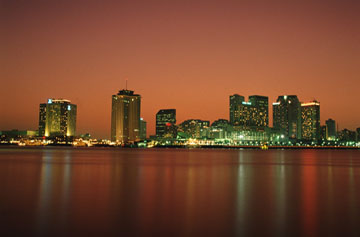

So I have strong, complex, emotions when it comes to New Orleans. It is one of my favorite US cities, in part because being there has always felt like NOT being in the United States, but in another world. It was summer, humid and rainy, the last time I was there, and I made notes for a poem about the place and my feelings, watching the city's and my own histories collide, mesh, and swirl as the rain splattered the car's windshield, and in my notes I called it an 'aqueous city'. Now, of course that phrase has yet another meaning.
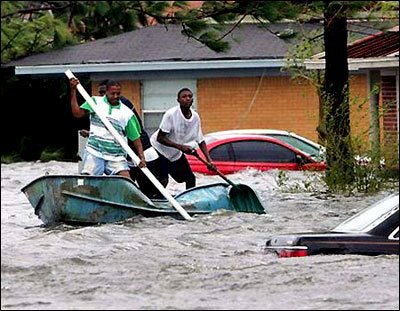

One of the great failures post-Katrina failures to my mind is our failure of vision. As appalled as I was by what happened (and didn't happen -- and hasn't happened yet), I am most dissapointed and infuriated by the lack of realization by the powers that be that we have also been handed an amazing opportunity. How many times have we been able to rebuild an entire city? The last time was around the turn of the last century, from, the 1871 Great Chicago Fire to the 1904 Baltimore Fire to the 1906 San Francisco Earthquake, there were an unprecidented series of disasters befalling American cities, leading to the need to rebuild. Citizens and city planners got together and transformed these cities, creating the outlines of the great metropolises we see and live in now.
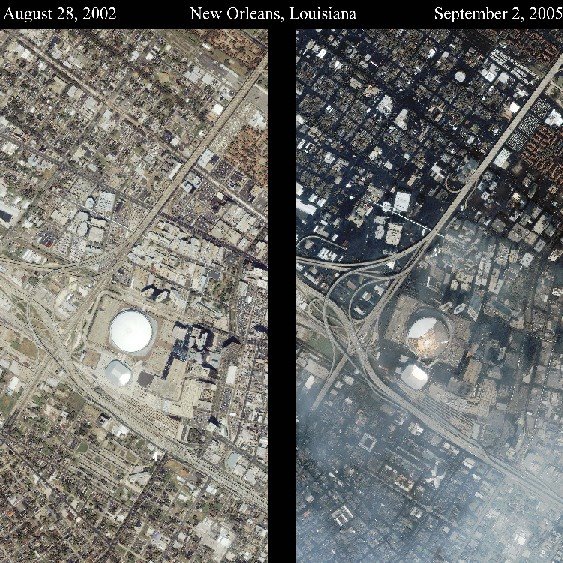

Katrina should have been another one of those opportunities, a call for planning, innovation -- and vision. I've always thought there should have been a blue ribbon planel of architects, environmentalists, developers, city planners, private citizens from all walks of life and economic levels, business people, and politicians brought together to discuss the future of New Orleans and the Gulf Coast. How do we build a city below sea level? What can be done to minimize the impact of storms to come (the Weather Channel is on as I type this, with reports on Ernesto in Florida)? What kind of life do we want to create for the citizens of Louisiana, Missississippi, and Alabama? Yes, rebuild, yes, restore and strengthen the levees, yes bring back The Saints and Mardi Gras. But who is thinking about the future? Where is the vision? Who is talking about the possibilities offered to us as we rebuild? Certainly not Our Current President, who continues to spout platitudes. But someone has to do this. Someone, somewhere has to be able to dream -- and then go to work.

Oh yeah, we're using our "Vision" to rebuild Iraq. And as this is also the one year anniversary of the cliche 'Playing the Blame Game' I really should leave Dubya alone. Yeah, right...
(the only people who use that Blame Game phrase were folks trying to run away from responsibility. IMHO there was and continues to be enough responsibility/blame to go around).


In honor of Lorca and The Gulf, here's the final section of the poem "New York (Office and Denunciation)" from the collection Poeta en Nueva York which seems especially appropriate today.

I also CANNOT RECCOMEND HIGHLY ENOUGH Spike Lee's masterpiece When the Levees Broke: A Requiem in Four Acts. It is absolutely essential viewing, and should be seen by everyone.

Nueva York (Oficina y denuncia)

Yo denuncio a toda la gente
que ignora la otra mitad,
la mitad irredimible
que levanta sus montes de cemento
donde laten los corazones
de los animalitos que se olvidan
y donde caeremos todos
en la última fiesta de los taladros.
Os escupo en la cara.
La otra mitad me escucha
devorando, cantando, volando en su pureza
como los niños en las porterías
que llevan frágiles palitos
a los huecos donde se oxidan
las antenas de los insectos.
No es el infierno, es la calle.
No es la muerte, es la tienda de frutas.
Hay un mundo de ríos quebrados y distancias inasibles
en la patita de ese gato quebrada por el automóvil,
y yo oigo el canto de la lombriz
en el corazón de muchas niñas.
óxido, fermento, tierra estremecida.
Tierra tú mismo que nadas por los números de la oficina.
¿Qué voy a hacer, ordenar los paisajes?
¿Ordenar los amores que luego son fotografías,
que luego son pedazos de madera y bocanadas de sangre?
No, no; yo denuncio,
yo denuncio la conjura
de estas desiertas oficinas
que no radian las agonías,
que borran los programas de la selva,
y me ofrezco a ser comido por las vacas estrujadas
cuando sus gritos llenan el valle
donde el Hudson se emborracha con aceite.


New York (Office and Denunciation)

I denounce all those
who never think of the other half,
the irredeemable half,
who raise their mountains of concrete
where the hearts of little
forgotten animals beat
and where all of us will fall
in the final fiesta of jackhammers.
I spit in your faces.
That other half hears me,
eating, pissing, flying in their purity,
like the supers’ children
who take their flimsy palettes
to the holes in spaces where
insects’ antennas are rusting.
This is not hell, this is the street.
That is not death. That is the fruit stand.
There are broken rivers and distances just out of reach
in the cat’s paw smashed by a car,
and I hear the song of the worm
in the hearts of many young girls.
Rust, fermentation, earth tremors.
You yourself are earth drifting among numbers in the office
What am I going to do, put the landscapes in their right
places?
Put in good order the loves that soon turn into photographs,
that soon become pieces of wood and mouthfuls of blood?
No, no: I denounce,
I denounce the conspiracy of these deserted offices
which erase the plans of the forest,
and I offer myself as food for the cows milked empty
when their bellowings fill the valley
where the Hudson becomes drunk with oil.

Federico García Lorca, 1929-1930

(translation by Galway Kinnell)

18 July 2006

Art and 'Security' (or Bringing Home the Bacon)


After the recent death of director and Yale Drama School Dean Lloyd Richards (...am I the only one who loved the coincidence that he shares a name with the playwright actor Hugh Marlowe plays in "All About Eve"?), poet Elizebeth Alexander shared this excerpt from from an interview filmmaker St. Clair Bourne did with him in 1999, for Bourne's documentary on Paul Robeson, 'Here I Stand':

"My biggest hurdle of course, was not the fact that there was no opportunities out there or very few -but what do we say to my mother, who really was looking forward to my being a doctor - and I had already reneged on that and was now going to be a lawyer. And she had adjusted to that and how would she adjust to the fact that I wasn't even going to be a lawyer. I was going to go into this no-named profession, where there was no possibility of acquiring anything, certainly stability, or security, and that's what I was going to college for, she thought - for security. And I had to take really stock in myself and ask myself that question…what is security, for me. Is security money in the bank? Is security having a home that one is paying on? Is having a bank account… Is that security? Or is security getting up in the morning, and not counting the hours? And I decided, that for me, security was that. Getting up in the morning and not counting the hours and in the theater, there's a place where I did not count the hours - where you simply do the work, and you live off the doing of your work. You're in it, trying to accomplish it. And so, just after, I encountered Paul [Robeson], who was a factor in that decision, I decided to commit to the theater."

I've been thinking about this recently, particulary since I too had parents who drilled into me the notion that one had to 'put food on the table.' I remember from a documentary on Andy Warhol, one of his assistants saying that he too kept talking about having to go out and 'make the bacon', which may have something to do with the celebrity portraits he did during the 1980s which often graced the cover of Interview magazine. Your parents or someone is always worrying that, if you're an artist of some type, you're going to wind up starving in a garret somewhere, or out on the street.

"Get a real job," is something one hears all the time -- and it could be part of the reason why I do in fact have a 'real job' only tangentially related to writing. As someone pointed out to me a number of years ago, I am often like the persona in John Ashbery's "The Instruction Manual", which begins:

As I sit looking out of a window of the building
I wish I did not have to write the instruction manual on the uses of a new
metal.
I look down into the street and see people, each walking with an inner peace,
And envy them--they are so far away from me!
Not one of them has to worry about getting out this manual on schedule.
And, as my way is, I begin to dream, resting my elbows on the desk and leaning
out of the window a little,
Of dim Guadalajara! City of rose-colored flowers!
City I wanted most to see, and did not see, in Mexico!


I love Richards' comment about REAL security, and that place where one does not count the hours. So beautiful about being in your creative space, and so true. I also recently read this, from Julia "The Artist's Way" Cameron:'

Dear X,
I recieved your disheartening letter conveying the fact that your family was urging you again to "be sensible." I have never understood what was "sensible" about trying to ignore the things you love. What is it about being a declared artist that people find so threatening? I don't know. In any case, I am sorry for the pressure you are under and suggest you repeat to yourself the following: "If I give in, I will only feel more pressured, not less."

Ours is a pedestrian culture. We have no place in it for the "calling" to make art....There is honor to following your vocation...Beyond honor, there is also the matter of success. I think of that as "filling the form," as in "If the shoe fits, wear it." In other words, if you are called to be an artist, you may just be supposed to be one. And who is to say you will not be an successful one, even in worldly terms....

I do not think, for myself, that the money can be the only measure of success, although in America we are certainly clued to think of it as the foremost. I think there is something to be said for feeling that we are in our proper role, that the shoe fits, as I said before, and taht we can walk in our shoes without them pinching. I am friends with a writer, an estimable writer, who for eleven years cleaned houses and washed dishes to support his writing habit. That's a lot of dishes and a lot of dusting. But it was also many years when he went to the page a happy man. I will tell you something else about this man. He is comfortable in his own skin. He seems to be aging well, with a sense that his life has been well spent. That happiness and sense of right action must count for something.
(Letters to a Young Artist: Building a Life in Art by Julia Cameron)

And this brought me back to one of the most moving letters I have ever read, one that I loved so much I used to carry a copy of it around with me in my wallet. It's by poet Hart Crane, to his father, who had recently offered him a 'good job' working for the family business. Here's an excerpt:

To Clarence Arthur Crane
January 12, 1924

My dear Father:
...I don't want to use you as a makeshift when my principle ambition and life lies completly outside of business. I always have given the people I worked for my wages worth of service, but it would be a very different thing to come to one's father and simply feign an interest in fulfilling a confidence when one's mind and guts aren't driving in that direction at all. ...

You will perhaps be rightously a little bewildered at all these statements about my enthusiasm about my writing and my devotion to that career in life. It is true to date I have had very little to show as actual accomplishment in this field, but it is true on the other hand that I have had very very little time left over after the day's work to give to it nd I may have just as little time in the wide future to give to it, too. Be all that as it may, I have come to recognize that I am satisfied and spiritually healthy only when I am fulfilling myself in that direction. It is my natural one, and you will possibly admit that if it had been artificial or acquired, or a mere youthful whim it would have been cast off some time ago in favor of more profitable occupations from the standpoint of monetary returns. For I have been through some pretty trying situations, and, indeed, I am in just such a one again at the moment, with less than two dollars in my pocket and not definately located in any sort of a job.

However, I shall doubtless be able to turn my hand to something very humble and temporary as I have done before. I have many friends, some of whom will lend me small sums until I can repay them -- and some sort of job always turns up sooner or later. What pleases me is that so many distinguished people have liked my poems (seen in magazines and mss.) and feel that I am making a real contribution to American literature...If I am able to keep on my present development, strenuous as it is, you may live to see the name "Crane" stand for something where literature is talked about, not only in New York but in London and abroad.

You are a very busy man these days as I well appreciate from the details in your letter, and I have perhaps bored you with these explanatioins about myself, your sympathies engaged as they are...Nevertheless, as I've said before, I couldn't see any other way than to frankly tell you about myself and my interests so as not to leave any accidental afterthought in your mind that I had any "personal" reason for not working in the Crane Company. And in closing I would like to just ask you to think some time, -- try to imagine working for the pure love of simply making something beautiful, -- something that maybe can't be sold or used to help sell anything else, but that is simply a communication between man and man, a bond of understanding and human enlight[en]ment -- which is what a real work of art is. If you do that, then maybe you will see why I am not so foolish after all to have followed what seems sometimes only a faint star. I only ask to leave behind me something that the future may find valuable, and it takes a bit of sacrifice sometimes in order to give the thing that you know is in yourself and worth giving. I shall make every sacrifice toward this end.

Affectionately, your son


16 July 2006

Acting Just So


This weekend I had the pleasure of being one of the judges for the national finals of NAACP's Academic, Cultural, Technological and Scientific Olympics (ACT-SO) competition, in Crystal City, Virginia. I've been a judge and assisted a few of the young people involved here in Baltimore, but this was the first time I'd been to the Nationals.

I confess to being somewhat less than enthusiastic about doing the local competition, because I'm not really a 'slam' or 'spoken word' person, and the majority of the work that gets submitted falls into that category. I worry that I might not be fair to the young people since it's 'not my style'. However, more often than not I do it, thanks to some discussions about this subject with other current and former poet-judges, and because I do know and enjoy the work of a number of spoken word artists. We all recognize the fact that, while yes the poem comes to life on stage, but its really not going to be strong if the craft isn't there beforehand on the page as well. As much as I moan and complain about having to get up early on a Saturday morning to do it, the talent and enthusiasm of the kids always energizes me the moment I get there. And the last time I judged, someone turned in a sonnet -- so much for stereotyping the Younger Generation!

I always wind up feeling a great deal more hopeful about that Younger Generation and the future of the country after doing the local event, and Nationals was no different, just on a larger scale. It was amazing to see a hotel filled with bright and highly talented black teenagers, buzzing with excitement and energy. Walking through the halls one had to be careful not to bump into someone leaping to the ceiling, practicing for the Dance competition, or interrupt young actors and actresses running lines with proud moms, dads, aunts or uncles looking on. The energy, drive, and sheer mindboggling ambition of these kids was extraordinary. Most of the young people I talked to were looking forward to pursuing double majors in college, and one young man aspired to both double majors and double minors. He made the rest of us 'old heads' seem like real slackers.

Some of the other judges included photographers Linda Day and Carl Clark, my friends and poets Kwame Alexander, and Linda Joy Burke, and others. I judged the Original Essay category, along with poet, filmmaker, and editor of the new anthology Growing Up Girl: An Anthology of Voices from Marginalized Spaces, Michelle Sewell. Before coming to Nationals and meeting the students we had to read and evaluate 48 essays, over a wide range of topics from African-American role models to quantum mechanics. In some ways, our talks with the students felt almost like mini-dissertation defenses: come in, discuss what you wrote and why you wrote it, try to win over the panel.

What is this thing called Essay?
Oddly enough, the question we asked just about every student also turned out to be the hardest for them to answer: What is an Essay? We could tell from our reading that surprisingly few knew what it was, and its form. In the Original Essay category we got short stories, speeches, memoirs, term and research papers, religious praise pieces, but very few actual essays. For most of the kids, they answered the question with 'TO ME, an essay...' and usually wound up by saying that it could be pretty much whatever kind of thing they wanted to write. A couple said "I don't like rules, so I broke them." At least they were being true to themselves and their definitions, or lack thereof, in the work.


Back to The Black Table
It was striking how many of the young people we saw were 'the only' or 'one of the few' black kids at predominantly white schools. Michelle and I were both curious about their experiences there, and whether, as Michelle said to one, the "MTV Generation" is really seeing beyond race and just accepting people as they are. THe sad report from the youngsters we spoke to is that this is not the case. Kids are facing some of the same kinds of comments, "jokes," and lack of understanding that people in my generation faced. One young man's paper was in fact about this very problem. While the media may appear to be more mulitcultural than in the past, it appears that old attitudes and mindsets die hard.

No Boyz Allowed?
Of the 48 entrants, only 12 were male. There were a number of other young men throughout the Nationals in other categories, but I hope the relatively small number of guys with essays does not mean that men aren't into writing.

Page vs Personality
One of the most striking things we noticed was the 'disconnect' between what the young people wrote and who they were and how they came across in person. Extremely bright, high energy, passionate kids would come in having written solid, fact filled, but ultimately slightly plodding papers. Why wasn't that drive and energy on the page? They could talk very eloquently and vibrantly about topics, be it the role of women in Afganistan, stem cell research, or affirmative action, but somehow they felt that when writing about it they had to be stiff, formal, and a bit pedantic. Time and again Michelle and I wished that the kids we talked to had put some part of their wonderful selves on the page. How are kids being taught writing these days? What are they taught?

What does the 'A' stand for?
Related to that, we were also somewhat suprised by the number of kids who proclaimed themselves to be in AP English whose work to our minds didn't seem to be at that level. I can think of only one paper I read from someone who said they were in AP seemed to show their work in that class to me, by the complexity of their sentence structure and some of the words they used. The others... pretty standard for basic English, okay, but Advanced Placement English? Whether it was a reflection on AP or the level of the 'regular' English class or not we weren't sure, but in either case, Michelle and I were ready to put the smack down on any number of teachers and school administrators by the end of the day.


It was a VERY full day for us. We saw our first young person at 9 am, and, after breaks for lunch and dinner, sent the last one off after midnight. The the energy, intelligence, drive, ambition, and sheer joy and exuberance coming off these kids kept us going throughout the day. And there were a number of truly wonderful surprises as well. Kids who wrote astonishing, moving and at times horrific stories about their growing up turned out to be some of the most sharp, polished and put together young people we'd ever met. They managed to (WARNING: Cliche Alert!) not only survive but thrive -- truly inspiring. Although they may not know what an essay is, we ran into some 'real writers' in our group, young people with great eyes for telling detail, color, who know how to pace their writing, and one young lady who had a near-professional ability with handling transitions in time (we strongly encouraged her to continue the mini-memoir she had turned into us, and Michelle wishes she'd had her piece for the Growing Up Girl anthology, it was that fantastic).

We met a future political speechwriter (either that or he's the next Bill Clinton -- and a future Hillary was there as well), budding Opera and classical music composers (which really excited me:), future neurosurgeons, doctors, physicists, and psychologists, mathematicians and 17-year-old entreprenures with their own brochures. One bright but somewhat shy young man sadly didn't realize he also has a natural, very amusing, dry wit. Another we wished we could connect with a third entrant's parents to give him a bit more focus. One paper had us crying out for an editor to take just one quick pass at it, since it was this shy of being something really special. In another case, we were sorry to hear an entrant say she had changed the name of her work at someone else's suggestion because the title we thought would be the 'better fit' for it was in fact the one she originally had.

It was a great couple of days, and almost heartbreakingly inspiring. These are the kids one wants to introduce to counter the stereotypes about 'troubled black youth', or to answer concerns about 'the future of young people in this country'. If these kids are a snapshot of what's really going on out there, and if adults don't mess them up, overall I think we'll be fine.

Just keep them away from AP English!

Vive le (true) France


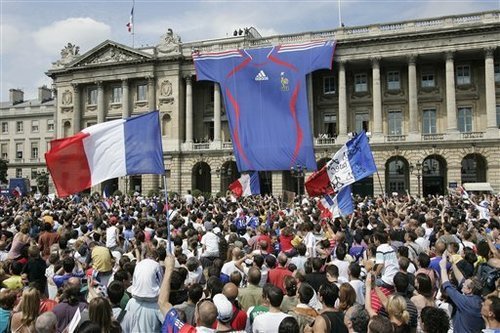
Fans wave flags in front of a giant jersey of the French team which hangs on the front of the Hotel Crillon in Paris, Monday July 10, 2006. France was stricken and shamed by Zinedine Zidane's brutal exit from soccer's biggest stage, yet the nation's president proudly embraced the favorite son, and masses of fans appeared to forgive the national hero who carried his team to the World Cup final, even if they didn't bring home the trophy. (AP Photo/Michel Euler) (http://fifaworldcup.yahoo.com)


As if playing in the World Cup final wasn’t pressure enough...(f)or France, there’s the spectre of Jean Marie Le Pen, the leader of the extreme right-wing National Front and candidate for the presidency, who complained that the French national team, with its 16 nonwhite players, didn’t resemble French society as a whole. “Perhaps the coach exaggerated the proportion of colored players,” he told L’Equipe. “The French don’t feel totally represented, which explains why the crowds are not as supportive as eight years ago.”
http://stevegilliard.blogspot.com/2006/07/world-cup-open-thread_09.html


"What can I say about Monsieur Le Pen? Clearly, he is unaware that there are Frenchmen who are black, Frenchmen who are white, Frenchmen who are brown. I think that reflects particularly badly on a man who has aspirations to be president of France but yet clearly doesn’t know anything about French history or society.

"That’s pretty serious. He’s the type of person who’d turn on the television and see the American basketball team and wonder: 'Hold on, there are black people playing for America? What’s going on?'

"When we take to the field, we do so as Frenchmen. All of us. When people were celebrating our win, they were celebrating us as Frenchmen, not black men or white men. It doesn’t matter if we’re black or not, because we’re French. I’ve just got one thing to say to Jean Marie Le Pen. The French team are all very, very proud to be French. If he’s got a problem with us, that’s down to him but we are proud to represent this country. So Vive la France, but the true France. Not the France that he wants."

(http://football.guardian.co.uk/worldcup2006/story/0,,1809453,00.html)


French defender Lilian Thuram


(...and Merci John)

05 July 2006

Poem: Is English Your First Language?


I just realized that, although I've been meaning to post poems here, I've been very bad about doing so. To remedy that, I thought I'd put up this one, which appeared in Issue #48 of Washington DC's grand annual literary cornicopia Gargoyle. Many thanks to Richard Peabody and everyone at the journal, and those who were at the launch reading in DC, (where The Other Half took this photo of your less-than-regular Blogger on stage)


Is English Your First Language?

Try evasion, ellipsis, and regret.
Or silence, unabridged, volumes spoken
with a whisper, encyclopedic furtive glances
in an echoing house dressed and lit for Scenes
of Childhood
, the ever changing lines rewritten
every night. Improvisation: American family breakfast – action!

Primers on mind- and palm-reading the most helpful
dictionaries for translating the fading Braille of a hard
sentence across the butt, or face. Code- and willow-
switching learns you good: English is a conditional tongue:
only adults can misuse it, curse, or lie.

When outside the house say ___

Outside the family say ___

When white folks are around, say nothing.

22 June 2006

Inside Cave Canem


Unlike Las Vegas, what happens at the Cave Canem: Black Poetry Workshop/Retreat doesn't stay at Cave Canem (well, SOME things -- like lousy drafts of poems -- do stay there but not everything...) People those of us who have been through the three year program always find it difficult to explain to people what the big deal is: the excitement of being part of a large, diverse group of black poets, the all nighters you pull in order to produce a poem every day for a week, the strong sense of connection you feel with others who've been through it. Call it Poetry Boot Camp, or the 'Black Breadloaf,' there's something special that happens when you bring a group of talented African-American writers together that's almost impossible to describe.

But now someone's attempting to do just that. Tyehimba Jess is now blogging from this year's retreat on Dog Bytes, recording the sights and sounds of the week. In addition to being an amazing poet (you do have his award-winning book, Leadbelly, don't you?), performer, and the first person I met at my first year at the retreat, he also has great blog experience from doing one of the Poetry Foundation's Journal's earlier this year. A sharp observer and an entertaining writer, his account of the week is the next best thing to being there.

30 May 2006

BEA Blog: Day 4


When they begin playing John Philip Souza marches on tubas, you know it's time to go....

Last day of BookExpo and I have the mixed emotions. Very happy, tired (I won't realize how sore from tote-ing books I'll be until well after I'm back home), glad I came -- but also glad to be leaving. There's only so much of this one can take! I repeat the same joke to three people I talk to today: BookExpo is like crack for booklovers.

Spend the morning with Teri and her husband Hayes at breakfast in Silver Spring. Both poet-hyphenates (poet-arts administrator, poet-teacher), they are filled with energy and ideas, and I'm struck by how 'young' they are. Either that or I'm just getting old. I try to insist, particularly to Teri, on the need to slow down, that one can't do EVERYthing, that choices have to be made (you can either watch all those TIVOed episodes of "24" or you can write, but maybe you can't do both), but am not sure I get through. I give them a writing assignment for their upcoming trip to Paris: spend a day walking through the city without a plan, just observing, and come up with notes to write a series of poems "Morning in Paris," "Noon in Paris," etc. Yes they will be 'doing something' but it's also a round-about way to get them to slow down and observe, to just enjoy 'being' for a while. It is obvious thaty they enjoy being with each other, and its very touching to see them unconsciously do little things for each other. Ah, married life...

The three of us also notice how we are in a room in the restaurant where there are no white people. Everyone in our area is black/brown. The restaruant is full, and perhaps 70% black, so perhaps its just a coincidence. But, this being the USA, one never knows...

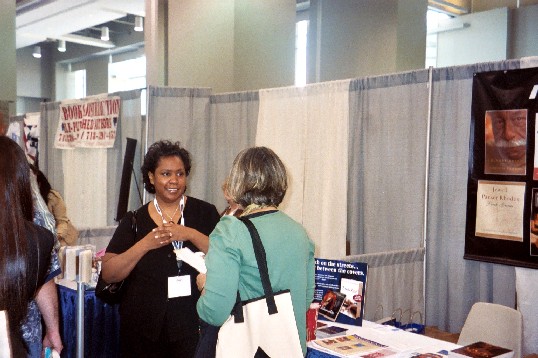
Back at BookExpo. It is a fantastic but humbling experience to be a writer here. Fantastic to see so many books and publishers and other authors. (A photo of Zane in the African American Pavillion)
But also humbling: how can your one little book possibly break through when surrounded by all this? It reinforces how much work it takes to even try to make it in the writing world, let alone an 'overnight sensation'. I'm struck by how a few of the smaller presses and self publishers are relying on outlandish costumes or gimicks (viz the tubas) to draw people to their booths. Much of the time, it doesn't work, and only makes them look desperate and a little sad. The 'big boys' don't need to do that (although one has a Johnny Depp look-alike in their booth to push a 'Pirates of the Caribbean' tie-in).

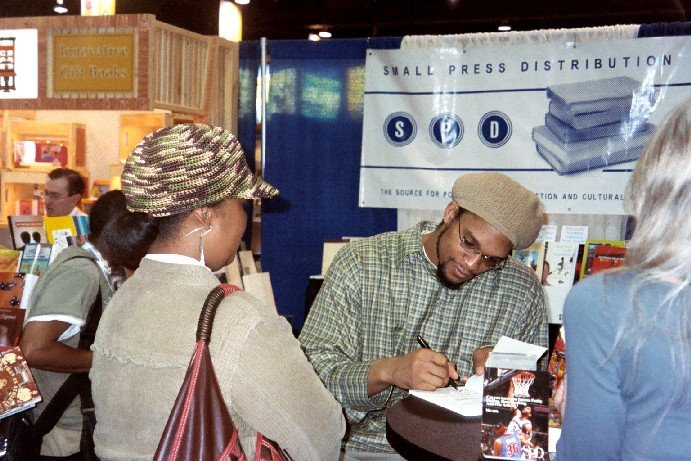
Someone in the booth next to Small Press Distributors hears my name and comes over. "You're a poet, aren't you? You've been published, right? I've read your work!" I'm dazed and happy, but also a little unsure. This has happened to me before, in Chicago in 2002, at the Fire and Ink Conference, where someone said, "Oh I have all your books," and proceeded to pull out the collected work of Reginald Shepherd. I suspect this is the case here as well, but I'm gracious and thank the guy. Have to remember to tell the 'Other Reginald' that I met one of his fans....

(Non-chronological aside: This is not the last time I'm mistaken for someone else in Washington DC. Memorial Day Weekend I'm standing in the Lambda Rising bookstore awaiting the start of a reading for Spirited, when an older black woman comes up to me and asks, "Are you E Lynn Harris?" *Sigh*)

Some authors are signing in booths on this final day, and publicists and others with their presses are in the asiles like Carny barkers, drawing people in. "Author signing copies right now!" they say to passers by. Some people however don't need this: the longest line of the day is in the morning for Alice McDermott, in the FSG area. I make it there in time to see her and get a book. I mention being from Baltimore and she whispers to me, "How do you think O'Malley's going to do?" (our Mayor is in the Democratic primary for Governor of Maryland). I say, "I keep worrying they're going to pull out some dirty tricks on him." McDermott nods sadly, and moves on to the next fan.

The last day of the convention can often be a good day for 'hunting and gathering'. Vendors are giving away books they don't want to box up and ship back to their home offices. Some are selling things ("Make me an offer" one says), others not (inspite of our hovering and salivating, coffee table book publisher Taschen ain't givin' up nothin'). There's what can only be described as a frenzy in front of Merriam Webster. You know you're among SERIOUS book and word lovers when you see folk scrambling for dictionaries! It's One Per Customer here, and the MW people are bringing out the title you want. I decide to step aside to allow an over excited teenaged girl to go ahead of me so she can get a thesaurus before she explodes.

I run into Kwame Alexander again, and apologize for missing his party. He understands and says he was exhausted as well, but since people had already been invited he as host couldn't not show up.


Someone points out to me that being from the library makes me a bit of a VIP. Marketing people and publishers spring into action when I mention 'Big city public library', and go looking for books and catalogues, some even offer to mail titles to me once they get back to their offices. Gee, the prospect of sales of 50-100 copies of a title in one order tends to get folks moving, doen't it?

More food (carrot cake with almonds today), a few more signings. The convention hall closes at 4 pm today, but at 2, the sound of adhesive tape being torn off rolls starts to be heard around the floor. Folks are starting to pack up. Wandering among the boxes, I review the weekend. I have few regrets. I only missed one author signing I wanted to make -- David Maraniss and his new Roberto Clemente bio. Otherwise, I'm well satisfied. So what if I missed presentations by Amazon and Google (who have a small fleet of cars to shuttle conventioneers back and forth to their hotels). I've been impressed by how much work gets done at this expo. An editor at Temple University Press described his day as "Breakfast with an author, lunch with two authors, dinner with an author tonight...." Every day I've seen huddles of people sitting at tables making deals and talking about books and the book business. I've surprised myself at how much work I've done in talking to publishers and authors. Its been a really grand four days, and I can't wait to go to BookExpo 2007 in New York City. First order of business next year will be to locate the shipping area, so I can start sending books back to myself from day one.

The weekend ends with what I can only describe as a perfect dinner at Udupi Palace in Takoma Park, a vegetarian South Indian restaurant. Everything is fresh, light, extraordinary, and our waiter looks like he just stepped out of a Bollywood musical. Good food, good friends, good conversation, and books: Heaven must be like this.

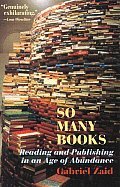
...And what do I do when I return from BookExpo? Why, order a book, of course!:) One final title, highly recommended during the convention: So Many Books: Reading and Publishing in an Age of Abundance, by Mexican author Gabriel Zaid (translated by Natasha Wimmer), from the small Philadelphia publisher Paul Dry Books. A short, beautifully written essay on books, reading, and writing, it elegantly states the case for the continued relevance of books as other technologies advance, as well as how reading creates connections between people. Its the perfect end to a perfect series of days.

"The freedom and happiness experienced in reading are addictive, and the strength of the tradition lies in that experience, which ultimately turns all innovations to its own ends. Reading liberates the reader and transports him from his book to a reading of himself and all of life. It leads him to participate in conversations, and in some cases to arrange them, as so many active readers do: parents, teachers, friends, writers, translators, critics, publishers, booksellers, librarians, promotors.

The uniqueness of each reader, reflected in the particular nature of his personal library (his intellectual genome), flourishes in diversity. And the conversation continues, between the excesses of graphomania and the excesses of commerce, between the sprawl of chaos and the concentration of the market."


28 May 2006

A Black man and two Latinos walk into a Chinese carryout....

A true story:

On my way back to a friend's apartment in Hyattsville and hungry, I stop in the Chinese carry out around the corner and order shrimp lo mein. As I'm waiting for the order, two Latinos (Mexican perhaps, or more likely Colombian), one in his twenties, the other forty-something walk in. The younger one is carrying a guitar, and both look a little tired and have possibly/probably had a few drinks. The guys order. I can tell from the repartee that they have been here before, and the older guy is playfully flirting, in English, with the Taiwanese woman taking the orders. From a previous exchange between herself and another Latino who ordered in mangled Spanglish, I believe she understands some Spanish, but doesn't speak it (she'd called over one of the male cooks to translate for her with the first guy).

As the woman puts an order on the counter and motions to me that it's mine, the older Latino takes the guitar from the younger guy and begins to play. He'd been facing away from me all this time, and it's only now that I see that he's wearing a Beatles t-shirt as he begins to sing:

Close your eyes and I'll kiss you,
Tomorrow I'll miss you;
Remember I'll always be true.


I know this song, I think, and so I sing along....

And then while I'm away,
I'll write home ev'ry day,
And I'll send all my loving to you.


.....and we laugh and shake hands. I wish all a good night, and head to my friend's apartment to eat.

An African-American and a Colombian serenading a Taiwanese woman with a forty-year old song by four guys from England, in a suburb of the Nation's Capital on Memorial Day/Black Gay Pride Weekend: Welcome to The United States of America, 2006

25 May 2006

BEA Blog: Day 3


Still under the influence of the Folger reading and reception, I wake up on Saturday morning and write a draft of a poem (No, I will NOT be putting it up here, so DON'T ASK!:). Over breakfast, the topic of Black Books and Street Lit comes up again. Thumbing through the Simon & Schuster African American catalog, I'm struck by how, well, awful, some of the covers for their 'street lit' books are. "It's like when you're first starting out and get one of your friends to design your cover," graphic designer Eunice Corbin says. We wonder if the lack of style or even attempt at quality depiction of figures on some of the covers is some kind of 'sign of authenticity' for these books. Since many of these authors did indeed start out self-published with covers by friends, it is perhaps a way to show that S&S is 'down wit dat' by reproducing crappy graphics. If this is the case, it also smells like a bit of a trick: Think you're helping a brotha or sista out by buying their 'I did this myself and selling it out of the back of my car' book when in fact it comes from one of the world's major publishers.

As much as I enjoyed being with Teri on Friday, following someone around and listening to their pitch, when it's not also your pitch, can get a bit tiring. I'm looking forward to being by myself for most of the day, and have a plan: Start at one end of the main convention floor and work my way aisle by aisle to the other end. What ever I miss I can make up and do 'mop up' on Sunday.

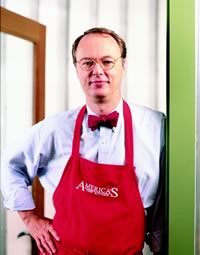
But first: the new America's Test Kitchen's cookbook. Its 10 am, the autographing doesn't start until 10:30 am, and already the line is like a bookaholic anaconda. The signing doesn't even start for another 45 minutes and there are more than 100 people in this line alone. Some of the others are long, some not, depending on the 'name' of the author. The America's Test Kitchen people hand out info about their other publications while we wait. These signed books are free, but there are glass containers at the ends of some of the numbered aisles where a suggested donation of $1 per book can be given. Soon, it's time to start, and the line begins to move. I've been told that Kimball does the quick sign and go thing, and the line does flow fairly smoothly. But he does engage in some chat with those who have been waiting. I ask for the book to be signed to The Other Half, and he asks if that's me. "No, but we both watch every week." He's handed a book, nods, signs, says thanks, and off I go.

By now most of the lines have calmed down (note to self: show up after the announced start time to avoid the crowd), and I stop by for books from a couple other authors, and head down to the main floor. Start at one end, up one aisle and down the other across and cover the entire floor.

There are things you can tell by both booth size and booth placement. On one end of the floor is the 'premium small press' area, where there are actual booths. At the other, where Teri and I saw Poetry, Gival Press, and others, are the, I suppose 'non-premium' small presses. They get a small table and one or two chairs, not really a booth. The majors are in the middle sections of the floor, with multiple booths, large displays, banners, etc. And better carpet. Yes, if you pay more, you can have something more plush to stand on than the standard hard on the feet indoor/outdoor carpet lesser mortals have. You can truly tell just by walking into a section who has spent some cash to be here and who's not.

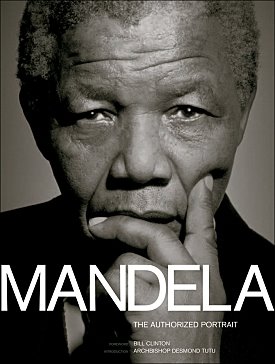
Another pointer for future convention attendees. On day one I said it's all about the shoes. When you're browsing and picking up items, it's all about the bag. If you're going to really stock up, canvas is better than paper (although I'm told that one publishers shopping bags are excellent and hold up very well). You want something that's going to last and be able to handle everything you pile into it. Some bags become the 'hot gets' of the convention. This year it's Captain Underpants, a series for young readers popular with kids that some parents have challenged in a number of libraries, and a bag for an upcoming Nelson Mandela photo book, with very striking images of the man himself on both sides. There are apparently enough Mandela bags to go around, but the Underpants have to be rationed (yeah, that's a phrase I couldn't resist), and only a few bags are put out each day, increasing the frenzy to get one. I get a mix of different types, canvas and shopping/paper, the paper bags acting almost as collectors items: City Lights books? University of Minnesota Press? How can I resist?

The bag issue becomes important at mid-day, as I have to take a break, and go to the convention center's food court. Yeah I know I said, "Bring a sandwich" but, well, you know...I make it with my multiple bags into the food court, order, get something and am about to try to find someplace to sit to rearrange what I've got when the strap on one of the paper bags breaks. Fortunately, out of the blue, a woman comes to my rescue, offering not only to take the food try while I regather myself, but even to take it to a table for me as I struggle. Its a small moment of kindness from one book-loving stranger to another, but I'm genuinely touched and I thank her profusely for her help.

And it's not like I'm indiscriminate in what I'm gathering. True there are a number of things that interest me personally, but coming from a 'bookish' family, I see things that would be good for my sisters, nieces and nephews, friends...It's like Christmas shopping early, and in fact someone I know does indeed hang on to items picked up at BookExpo until the holidays. I try not to pick up too many catalogues, and have learned from past conventions that without mailing tubes, posters get crushed very easily, so those are out. Fortunately, I call my friends, who were arriving later in the day, and they are on site. I can take my morning's haul to their car, and come back unburdened.

I go through the section of publishers from Spain, Argentina, Mexico and other Spanish-speaking countries for a collegue with an interest in Latin American issues. I've also been tasked to look for books and authors that might make good choices for programs at the library, and think I find one in Tom Sancton and his memoir of growing up in 1950's New Orleans, Songs for My Fathers. Also here, signing at the Small Press Distributors booth is poet, activist, and Washington Wizards baskeball player Etan Thomas, who I've been pushing to have invited to the library for almost a year. I talk to and exchange cards with his publicist. So, I'm working, I convince myself, I'm working. And I head down the aisle where most of the comic book publishers are.

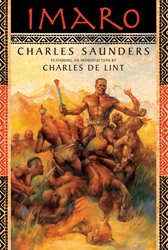
Its there that I pick up the Find of the Weekend: Charles Saunders' Imaro.


Originally published in the 1970's, Saunders was one of the pioneer African American SF writers, after Samuel Delany and Octavia Butler. After he moved to Canada, however, his books became increasingly hard to find and fell out of print. Originally marketed as a 'black Tarzan' when in fact it is a refutation of that character and those books, Imaro is the first in a trilogy of heroic fantasy books about an African warrior. Blood, guts, fighting, action, adventure, it's a stereotypical 'boys book' if there ever was one. And all Black, based on genuine African cultures, legends, and myths. I'm thrilled beyond belief by this reissue, and pick up TWO copies, which I don't let out of my presence for the rest of the day.

Connecting with friends blows the 'start at one end' plan, as they want to start at the opposite end from where I began, and we have a 'newbie' with us, who is dazzled and stops quite a bit. But its okay, I made it about halfway through, and going to the other side will leave only a 'middle section' I haven't covered.

As the afternoon wears on, some publishers start to offer things to entice tired Expo goers. Publisher TokyoPop (not with the rest of the comic/manga publishers, I notice, and sporting nice plush carpet) is offering free champange, which we sip while wandering into an area for a publisher with a number of Christian-oriented titles. I feel a bit self conscious about drinking there, but am reminded that 'they drank wine in the Bible' and continue sipping. Another publisher offers wine and cheese, a third Twinkies, still another amazing mac & cheese from Philadelphia. Famous Amos signs and gives away cookies.

Harcourt, which had been showing previews of the new version of Robert Penn Warren's All The Kings Men (Sean Penn's not bad, but I miss Broderick Crawford) has turned that off and their reps are watching the Preakness (I don't stay and miss Barbaro's accident)

Checking the time, I see its time to head up for Edward P Jones' autographing his new book of stories, Aunt Hagar's Children. I'd expected this to be a Christopher Kimball-like mess, but by not being in the area right at his start time, I've missed the mess, and have a short wait. I go up and greet him, shake his hand, remind him that he's been to the Pratt Library twice (once after his smash The Known World came out, and again later, within days of his winning the Pulitzer. He smiles and I think he rembers me (I'd done the introduction for him both times) but he does remember the library. He still seems a little reticent, but better than what I remember of his first reading, where he was a nervous wreck beforehand, which I put down to shyness. Later, someone that knows him well tells me that he's not as shy as I might think, and judging from how very dryly funny he can be during Q &A sessions, I can believe it.

I wander the autographing area a bit more, and notice a short line for another, different kind of star, former New Jersey Governor (and "Gay American") Jim McGreevey, here to push his new autobiography. I get in line...and wait...and wait...and wait. As the person at the head of the line leaves, she comments, "He's chatty," and apparently is asking everyone questions about where they're from, what they do, why they came, and so on. And he's not even signing the book, but a few page excerpt and book jacket mock-up. Seeing my friends in the area in front of the autographing aisles, as well as that there is an older gay male couple in front of me, meaning, I imagine a major debriefing by the Gov, I decide I can give McGreevey the slip, and leave. I do see him later, as he's leaving the building. Up close he looks heavily made up, and I assume he's done a session in the CSPAN Book Bus.

Either that or somebody went a little too heavy on the pancake this morning.

I'd run into writer and (former) publisher Kwame Alexander on four separate occasions as we traveled back and forth across the convention floor. He invites us to a party he's having at DC's new but already legendary BusBoys and Poets that night. We agree, but by the end of the day, and stopping in College Park for something to eat, all of us are completely dead by the time we get to Hyattsville. I hope Kwame understands.

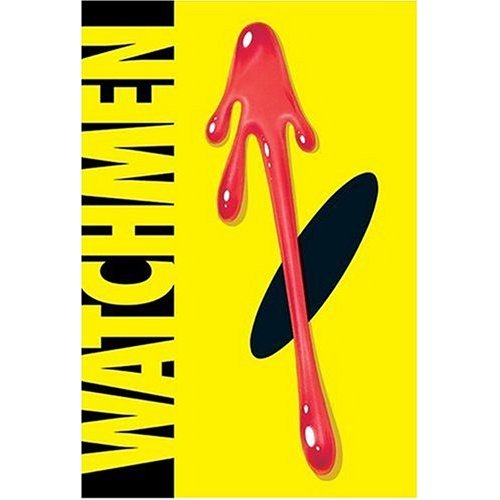
The three of us sort through our finds, sharing, exchanging, doing the 'ooh, where'd you find THAT!' thing over items we've missed. I end the day on the fold-a-way bed, flipping through Watchmen, and reading the introduction and authors note in Imaro. All three books to be reissued! Saunders is writing a new Fourth title to complete the series, then another book mixing African and Celtic myths and traditions! Feeling giddy like a kid again, I fall asleep tired and happy, surrounded by books.

23 May 2006

BEA Blog: Day 2

The day starts off with seeing a report on the NYT "Best Books" panel on the cover of the Show Daily, the free rag for conferees put out by Publisher's Weekly. "Not So 'Beloved'" reads the headline, and the article gives a pretty good precis of the discussion. Since I was taking notes during the session, I have a brief flicker and wonder if some of the people surrounding me will think that I wrote the article. And then, the day's first Celebrity Sighting: America's Test Kitchen's Christopher Kimball, striding quickly across through the registration area in a dark suit. I assume that he's attempting to travel incognito by not wearing his trademark bowtie. It seems to work, as no one appears to notice him but me. I try to point him out to my companion, Folger Shakespeare Library's Teri Cross, but Kimball's moving too fast -- and she has no idea who he is anyway. Obviously, she's not a (TV watching) cook.

This is the first time Teri has been to BookExpo, and the look on her face as she gazes out over the vast Washington Convention Center floor, filled with publishers and their books is priceless. It's like waking up on Christmas morning and finding everything you ever wanted under the tree. It seems almost too big, impossible to cover even in three days. Teri is only there one, today, and so she's going to have to be selective in indulging in this cornocopia.

Personally, I think she's wearing the wrong shoes. Looking sharp and attractive in a dark top and flowered skirt with a short but flowing train, she struts quickly through the aisles in heels. I know from past experience at Library Association Conventions that the key to these things is comfortable shoes or tennis all the way. But this doesn't stop Teri. She moves like a tiny whirlwind. Since she's only there one day, we decide to hit some of the big names and 'musts' for poetry. She's looking not only for publishers of poets she can bring to The Folger in her capacity as Poetry Program Coordinator, but also authors who can be part of the new "Words on Will" series, that attempts to show the influence of ShakeScene in the lives of a wide range of people. So just about anything and anyone might be qualified for this series. Most folk, however, tend to mention scholars and professors when "Words on Will" is brought up. "How do I say 'I don't want academics' without seeming mean?" she asks me. I suggest using words like 'for a wide audience,' 'engaging,'...'popular' perhaps?

Saying "Folger Shakespeare Library" causes a number of people to jump into action. One at Oxford University Press gleefully hands over a copy of the 1200 page Oxford Book of American Poetry gratis, as she strongly suggests David Lehman as a possible moderator for a poetry discussion, for example. I do what I can not to turn too many shades of green as I agree that Lehman would make a good discussion moderator, or even program focus all by himself.

Criss-crossing the convention floor, directory in hand, in search of publishers (W.W. Norton! Simon & Schuster! Ahh...Graywolf ...and FSG!!) perusing, talking, picking up freebies, (passing E J Dionne who's saying, "I came from a family that was always talking politics..."), I'm struck even more than usual by how much I adore the work of small presses. Their books and lists seem the most interesting, the richest in terms of subject matter, range of authors, and they do more to bring work back to life. I find myself reverting to 'fan' mode, going up and thanking folks at Soho Press for reissuing the fiction of Maria Thomas, Coffee House Press for their "Black Arts Movement Series" (They have a small display in honor of Gilbert Sorrentino, who died BookExpo Thursday). I HUG the folks at New Directions, after one mentions being the editor of A Certain Blogger's fantastic novel. The photo of Octavia Butler at the Seven Stories booth saddens me no end: the first and only time I met her was at their booth at a Library Association convention. The midsized presses also seem to have more galleys and books out for the taking, while the majors seem a bit chary, perhaps holding things back for later when their authors are available to sign them. Teri and I still make a trip back to her car, loaded down with bags of books and catalogues (that Oxford American Poetry is heavy as hell), and start in for a second go round.

The Washington area's Gival Press shares a table with the annual journal Gargoyle over at the far end of the hall, where a number of the REALLY small presses are. Poetry is out here in the Cheap Seats as well, which is odd considering how flush with cash the Poetry Foundation is. We rave about the series of Poet's Journals they've been doing (the favorite of the folks in the booth, and one of the most successful, seems to have been our friend Tyehimba Jess' series), and rave again when they show us the Poetry Tool , a new web feature that allows people to find poems based on not only title or first line, but also 'Occasion' (Anniversary, Birth, Father's Day...) or 'Category' (Relationships, Nature, Cycle of Life...). I can hear thousands of libraians sighing in joyous relief, and can't wait to tell the folks at work about this.

We stop by Old Cove Press in the hopes of seeing author Frank X. Walker, who we'll also be seeing later that evening at the Cave Canem reading.
I'm impressed by the enormous blow up of the cover of Frank's book, Black Box they use as a back drop for their table (and lets, face it, that is one Sexy. As. Hell. photo!), as well as all the other promotional material for him. But then when you publish a Lannan-winning author I guess you pull out the stops. It's also a bit of a surprise to me that the folks at Old Cove are white. It takes me two seconds to get over it: anyone who puts such obvious love and care into the quality of their books, and the promotional work they do for Frank X, I'm down with them and happy for him. And I was published by 'a couple-a white chicks' as they'd call themselves, too, so...

In Da Hood
We leave the main floor and head to the upper level, where many children's book publishers, Christian/religious publishers, and what's called 'traditional autographing' is taking place. Also in this area is the new African American Pavilion, two short aisles where black presses like Third World, and the Black Issues Book Review are located. I've been ambivalant about this are ever since I heard about it. It is not as out of the way as I'd feared, since it is just in front of the area where most of the 'big name' authors will be signing. The lines for autographs are very long, and snake into the asiles, so they will get some extra browsing by default. Seeing the lines also makes me consider rethinking my carefully thought out plan of whom I wanted to get books signed from up here.

Its good to see all the blackfolk together, and it does have a kind of family reunion atmosphere. This set up helps the smaller and self-publishers out tremendously I think. But I remain unsure. Because we were not published by black presses, neither Frank X or I would be up here. I also have to wonder how well Lisa Moore's LGBT-oriented RedBone Press would do rubbing kente cloth with some of the more Afrocentric members of the family. It also remains much easier to pass us by when we're up here together like this. And one of the major publishers of "Urban" books, Kensington is down on the main floor with the big boys, because while the authors, bookcovers and readers may be black, they're not a 'black publisher.'

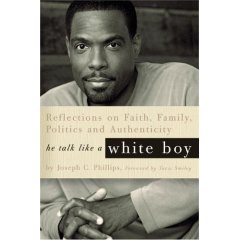
Actor Joseph C Phillips (AKA "Lisa Bonet's husband on The Cosby Show") is in a booth next to Zane and a number of her authors, signing his book He Talk Like a White Boy. People have said this about me many times (particularly when I'm on the phone), I've been interested in seeing him and the book since hearing about it in the pre-BEA promos. I've seen (at the Af-Am booksellers reception) or run into Phillips (on the main convention floor) a few times already. Teri and I wait in line in front of two guys ("After this we're leaving." "One more book and then we got to go.") and I get a signed book. Phillips totally spaces on the fact that while Teri and I are together, she'd like her own copy of his book. Considering how many people there are behind me, I can understand, and it's no big deal to her. A few minutes later I start to look at it, and my heart starts to sink. Praise-filled blurbs from Larry Elder? Shelby Steele? J. C. Watts?! WARD CONNERLY!?!?! Ohmideargawd, just what the world needs, another Black Conservative Republican! I decide I will give the guy the benefit of the doubt and try the book out, but still...sheesh...I looked forward to and waited in a line for this!? A chapter railing against 'Hollywood Liberals'?....Sigh...

CC at the Folger

After eating half a sandwich and drinking some water, and putting on a new shirt (which I'd packed along with copies of my own book and what I'm going to read), it's time for the Cave Canem reading at The Folger's Haskell Center. Scheduled to start at 7 pm, the first person, a friend of one of the readers, shows up around 6:15, but fortunately is content to wait as we finish setting up. Poets and audience begin to show up for a pre-reading reception, and it's reunion time. Some people I know only by their e-mail address, others I've not seen in years.

The reading starts late (no way does 'poets time' mixed with 'black time' equal 7pm on the dot) in part to wait for some missing readers to arrive. Holly Bass' father, for example, lets us know that Holly will arrive, but will be late as she's getting back into town from Philadelphia. I juggle the reading order to cover for the missing, and join Teri in playing host.

Cave Canem readings are legendary for both their quality -- and their length. Our poetic family can tend to go long. Fortunately this one does not. A couple of scheduled readers never arrive (Teri's husband, Hayes Davis jokes that one, DJ Renegade is probably sitting at the ESPN Zone watching the NBA playoffs), and everyone does a good job of obeying the '3-5 minute' time limit. In terms of quality, we all raise the roof, if I do say so myself. The range of styles and voices, forms and subject matter, of everyone -- Holly Bass, Derrick Brown, Carleasa Coates, Teri Cross, Hayes Davis, Deidre Gantt, Joy Gonsalves, Brandon D Johnson, Carolyn Joyner, Jadi Omowale, and Frank X Walker -- is impressive. I don't dare start talking about individual readers or poems (like Frank's linked black writer haiku, Teri on the Halle Berry/Adrien Brody kiss, Hayes as Huck Finn's Jim which had people applauding before he'd finished it, Holly Bass's Seven Crown Man...) because I'll leave out something great about the people I don't mention, when I enjoyed everyone and all were just stunning in their own way. The venue was filled, we sell copies of our own books and the Cave Canem 10-year Anthology, Gathering Ground, and everyone in the audience genuinely seemed to enjoy themselves -- including one woman who Brandon later says is a fixture at DC area readings, who bangs and shakes a tambourine after each poem she enjoys. Sitting in front and playing host, I'd just thought it was someone behind me with an excess of bracelets on her arm.

An early start and a long day tomorrow: I've been advised by an expert to get in line early for, who else? -- Christopher Kimball (wearing his bowtie, no doubt) at the first signing of the day. Edward P. Jones closes out Traditional Autographing at the final, late afternoon session, and I'm sure there'll be a long line for him as well. In between, "I have a Cunning Plan". Tired but happy, I'm wracked by a nagging thought: Where am I going to put all these books when I get home?

18 May 2006

Blogging BEA


(My apologies for the rough cut nature of this. I'll fix this up a bit with links, etc after I return)

Day one: Thursday May 18

Lisa Moore doesn't like the way Ernest Hardy looks. Or rather, Moore, owner/publisher/all-around-everything for RedBone Press is less than pleased with the way the cover of her latest book, BloodBeats: Vol. 1 -- Demos, Remixes & Extended Versions, a collection of essays, interviews, and reviews by Los Angeles-based writer Ernest Hardy has turned out. She has recieved a galley of the cover, featuring a black and white photograph of an African-American man in horn rimmed glasses' eyes and forehead against a black background, it is dark. VERY dark. You can barely see the guy. "It's like OJ on the cover of 'Time'," Moore says somewhat dejectedly. The printer had sent one set of proofs, which to her eye looked too light, and she'd suggested darkening the image.

They sure did that, all right, and the layer of lamination on the cover has made it even more opaque. Moore hopes that stopping the print run and sending the printer another version of the cover will fix the problem -- and that she won't be charged extra for their mistake. This may put a slight delay in the delivery of BloodBeats, which she'd hope to have available for advance and review copies next week. She's already in the midst of publicity for RedBone's latest effort, Spirited: Affirming the Soul and Black Gay/Lesbian Identity, and she needs to work on another book she has planned for Fall publication, which is already being considered as a required text at some colleges thanks to the promotional work of its author at conferences and meetings around the country. If it's not one thing, its three at the same time: Such is life for a small publisher, and the last thing she needs as BookExpo America kicks off.

All Hail The Queen

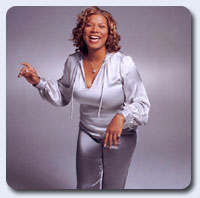
After walking from one end of the huge Washington Convention Center to the other (ie from subway exit to the front of the building where Registration is -- the somewhat discombobulated older black woman behind the counter starts my BEA experience off right by commenting that her husband and I have the same first name), I make my way to the area where the African American Booksellers Consortium is holding its programs. I've missed the opening lunch, and note that some others may have done so as well, but are making up for it, and have one, two, and in one case even three plastic covered 'box lunches' of sandwich, salad, and cookie in their publisher-supplied canvas bags. We're crowded into one of the rooms, waiting for Queen Latifah to arrive to give the Keynote to the group. Clara Villarosa of Harlem's Hue Man Bookstore vamps until she arrives. Latifah is resplendent in white and the crowd gives her a standing ovation. She proves to be extremely engaging, warm, and funny in person, and quickly has us all in the palm of her hand. She's there to promote a children's book she wrote, Queen of the Scene. Posters for the book are on every seat (I'm standing in the corner and don't get one). I'm very happy that The Queen names the late Octavia Butler as her favorite author. Apparently she's a Sci-Fi fan, and names Orson Scott Card as a favorite as well. I skip out during the Q & A to get something to eat (a Quiznos sandwich at outrageous Convention prices -- Note to self: bring your lunch tomorrow).

Quarter-Century's Best (Redux)

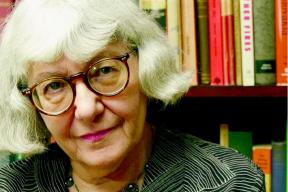
"Are the presenters here?" someone from the convention asks? A man in front of me says, "They're out in the hall." The person nods and starts to leave. "Well, at least ONE of them is here," someone else says. I look over and indeed one of the panelists is already in the room: white haired and owlish-looking Cynthia Ozick is sitting on the aisle amongst the rest of us great unwashed, waiting for the start of the session on the New York Times Book Review's recent "Best American Fiction since 1980" poll. Soon the rest of the panel arrives, looking like a law firm striding into court: Tannenhouse, Cowles, Mallon, and Schillenger, Attorneys at Law.

NYT Book Review editor Sam Tannenhouse says some of the impetus for their recent poll was from the mention on the cover of 'Invisible Man' that in 1965 it had been named "Most distinguished work of fiction since World War II". He wondered 'by whom'? and how was it chosen. Also in the mix were the many requests from people asking for suggestions of books to read.

It's interesting to me that no one on the panel had listed the eventual 'winner', Toni Morrison's Beloved as their top pick. Tannenhouse likes it, but thinks Song of Solomon (published pre-1980) a better book. I don't think he says which book he voted for. Thomas Mallon, another Song of Solomon fan, as well as of John Updike's Rabbit Redux, picked DeLillo's Underworld, even though he thinks there's a point in the middle where it sags, then picks back up again. Mallon also bemoans the fact that novelists don't write reviews anymore, and that the reviews they do write are all favorable. He misses the days when fiction writers wrote more non-fiction (Mailer, Baldwin, etc) and there was a vigorous magazine culture (Esquire in particular commissioned a significant number of pieces). He also thinks novelists 'should get out more' -- as in out of the academy, as he feels it is limiting their creativity.

Cynthia Ozick thinks the NYT should have asked for the "Best WRITER of the last 25 years" and praises Saul Bellow, thinking his work will endure. Her choice was William Gaddis' Carpenter's Gothic, although something about her comments leads me to suspect that that choice is something of a place holder for him since JR and The Recognitions were published before the 1980 start date. She doesn't care for Beloved, thinking, "it goes well in the History Department, Political Science, but doesn't fit in the Literature Department." This after praising the books' passion and compassion, and it's artful language. However, she doesn't care for the 'illusive, poetical, elliptical' narrative, and she cannot isolate one scene, voice or character. She also dislikes the dedication "60 Million and more" thinking its a poke at the Holocaust, and smacks of an attempt at setting up some kind of hierarchy of suffering. I like Cynthia Ozicks work, and respect her, but at this point she's starting to get on my nerves. She works me again later when she declares, "there's no such thing as experimental fiction any more. It's dead. It's all been done. What are you going to experiment on? There's nothing more 'old hat' than Experimental Fiction."

There's also an interesting side bar on how there were no 'younger' (40-something) writers on the list, and also how 'respectful' of their elders the current generation of writers were. Even the younger writers chose work by their elders. No Anxiety of Influence here it seems.

Part of the discussion turns into a Philip Roth love fest (as a Roth fan myself, I don't mean that maliciously), and the "Roth Mystery" as the panel trys to figure out how he manages to turn out such strong work again and again using what at first seems such simple vernacular language (Mallon points out his complex syntax and long sentences). Six Roth books were got a number of votes, and it looks like he (not Ozick's beloved Bellow, so there!) would be the judges' choice for 'Best Writer of the past 25 years.'

Someone from the audience (who appears to have an axe to grind -- twice he mentions sending cookies to the NYT Book Review office) asks about the relatively small number of women on the list of judges who votes. Tannenhouse says that over 200 writers were asked to participate; the names listed were the ones who actually voted. The number of women who chose not to participate was 'significant', he says....Again, interesting. I wonder why.

Another question: Will the complete list of novels suggested be posted to the NYT website? No plans at the moment but maybe. It might be interesting to see. None of the novels belwo the top 22 got more than two votes.

And I asked a question (a thick black man in a red shirt, close to the front, I'm easy to spot when my hand goes up) -- would they consider doing another poll for the 'missing years' 1965 - 1980. Tannenhouse says no, but someone else should. But not him. But that 'gap' does bother him. But no, not the Times. But someone should. But not him...well, maybe cause that gap really bothers him....but no...

If the Times Book Review puts out a "Best American Fiction 1965-1980", you know who to thank. (PS: I vote for Song of Solomon, followed by Gravity's Rainbow and Portnoy's Complaint)


The MFA vs The Ghetto
Back amongst the black folk (I was the only black male at the NYT presentation, but noted two black women and a few Asians and Latinos) they've already started the "Their Eyes Were Reading Smut" panel on 'ghetto/street/thug' fiction. The room is packed, as I'd suspected it would be, and there's at least one person (a woman in the front row) vigorously nodding her head at every pro-StreetLit statement. I worry if the convention needed to consider insurance against whiplash.

The presenters Malika Adero, Benilde Little, Nikki Turner, ask some interesting questions: are booksellers themselves obsticles to presenting the range of black fiction by having such huge, prominant displays of StreetLit to the exclusion of everything else? Turner says literary writers need to 'come out of their ivory tower' and relate to their audiences the way StreetLit authors do. "Talk to your fans. Take your book to the beauty shop and sell it!" Little bemoans the fact that she doesn't see the same level of artistic quality in the Street works she's read as she sees in the classic Manchild in the Promised Land. Adero and Turner (and the head shaker) immediatly disagree. "Its there! Its there!" but offer no specific titles.

Feeding Time
The African American Booksellers host an end of the day reception mixing food with free books and authors signing. A good mix of children's books, 'street lit', non-fiction, and literary novels. The 'divide' alluded to at the earlier panel disappears as folks crowd to pick up books and sip open-bar wine. Someone who works for the convention center comments on how good it is to see black people in a rush to get books, 'brain food instead of stomach food.' I nod and agree, although since the lines for the authors were so long, I decided to eat first and get books later. The well groomed brotha from the Convention Hall then mentions he's in line to get books for his wife. I wonder to myself why some straight guys feel compelled to mention their wives or girlfriends within the first five minutes of talking to someone. Do they think that others will think they're gay if they don't? Oh well.

I introduce myself to Passion Marks (and Passion Marks 2) author Lee Hayes as he waits for his books to arrive. He walks away to talk to friends and fellow authors and immediately someone asks me, "Are YOU Lee Hayes?" No baby, he's the Man in Black over there...

Villarosa tries to settle the crowd down to start the evenings program of award presentations. While she manages to quiet the crowd (after seeing her 'reading' someone for passing out flyers at the reception for his own events off-site, I know she's a woman no one wants to mess with) but after introducing the new owner of Black Issues Book Review, the group continually returns to schmooze and chat mode. Give us food, books and authors, then expect folk to be quiet? I don't think so...

The Road Home
Meet two librarians from Collection Management in the train station on the way home. We're all going back together. There were more posters available, and they both have signed pre-pub copies of Queen Latifah's children's book, which is quite nice and beautifully illustrated by Frank Morrison, and signed posters. AND a photo of the two of them with The Queen (who said to one, "You look like someone in my family"). I mention not sticking around to eat. "Just like a man, worrying about your stomach!" one says. Note to self: Be more patient.

Big day Friday: All day at the convention, a list of autograph sessions I want to attend, and if I can I want to catch Google's presentaion on their next steps in their efforts at World (Wide Web) Domination. Then the Cave Canem reading at the Folger, followed by the usual post-reading hang. Looks like a looong day....where are my sensible shoes?

Followers